Binary Tree Maps
Published On
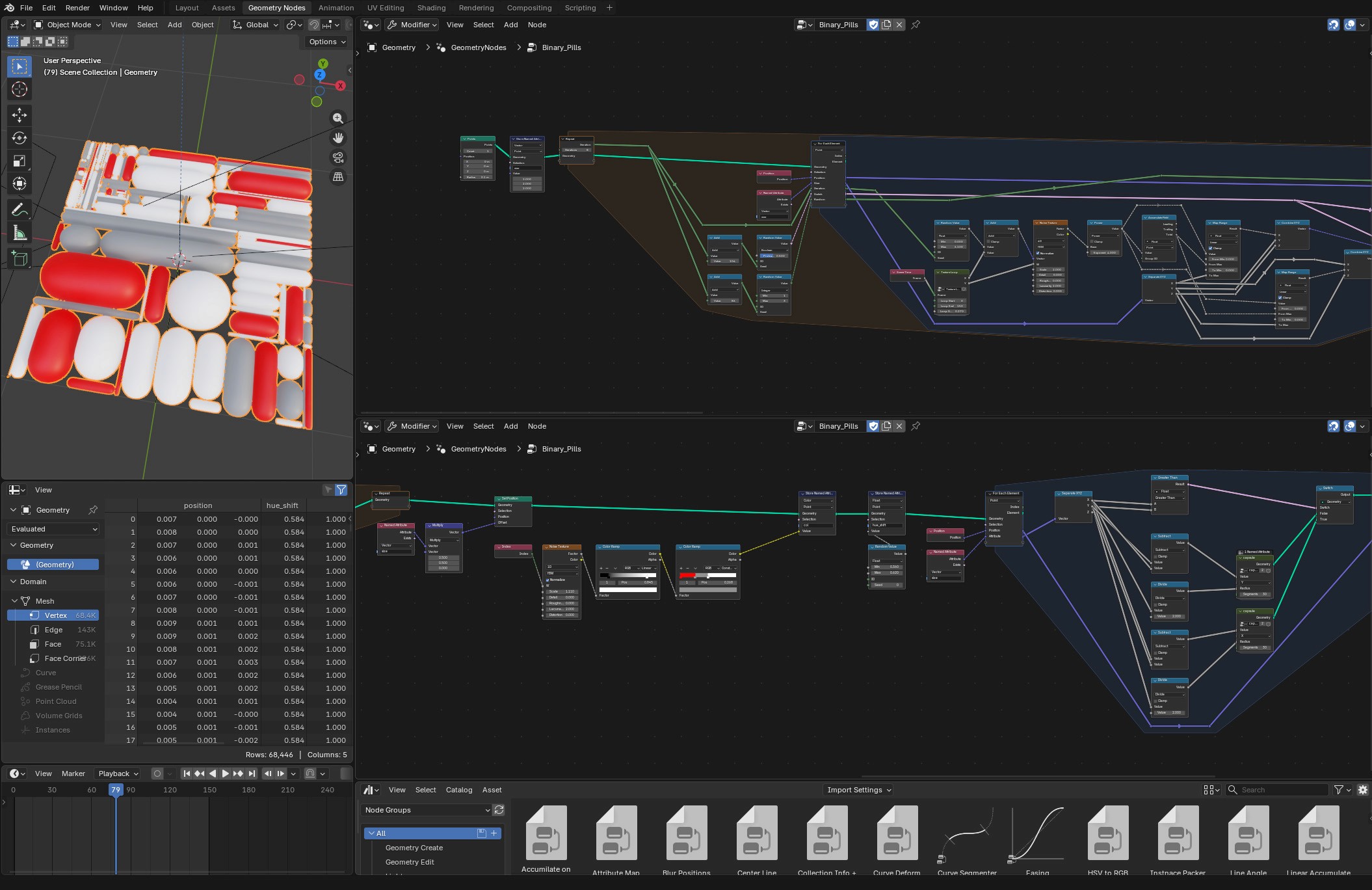
This study explores the visual potential of binary tree-map structures, executed within Blender’s Geometry Nodes. The foundational logic is simple: a single cell is recursively subdivided into two, alternating between horizontal and vertical axes. While this linear process creates inherent order, the focus of this experiment was to introduce layers of systemic "friction" to move the output toward a more complex, emergent aesthetic.
To disrupt the grid's predictability, I introduced stochastic subdivision, in which a probability gate determines whether a cell bifurcates or remains intact. This introduces a rhythmic randomness to the layout. Further complexity was achieved by shifting the subdivision ratio away from the standard 50/50 split. By driving this bias through animated noise and Voronoi textures, the grid becomes a living system, with cells expanding and contracting in a fluid, non-linear choreography.
While the standard intuition is to begin with a quad or grid, this system originates from a single point. By storing recursive parameters as attributes on the point rather than the mesh, I maintained a modular, low-complexity node tree. Although this approach sacrifices immediate visual feedback during the logic phase, it enables a highly efficient and scalable backend that remains performant as recursion depth increases.
A key breakthrough in this research was the implementation of spatial quantization. By constraining the divisions to integer multiples of a base unit, the resulting grids achieve a modular harmony. Every cell, regardless of its size, aligns to a singular underlying rhythm.
The final visual results are generated through instancing or "For Each Element" loops. This enables the logic of each cell to be context-aware; the form of an element can dynamically adapt based on the specific aspect ratio of its containing cell. A wide cell might trigger a different geometric distribution than a tall one, allowing for sophisticated, varied outputs.